NPS Survey Questions: The Standard NPS Question, 30 Follow-Ups
On this page
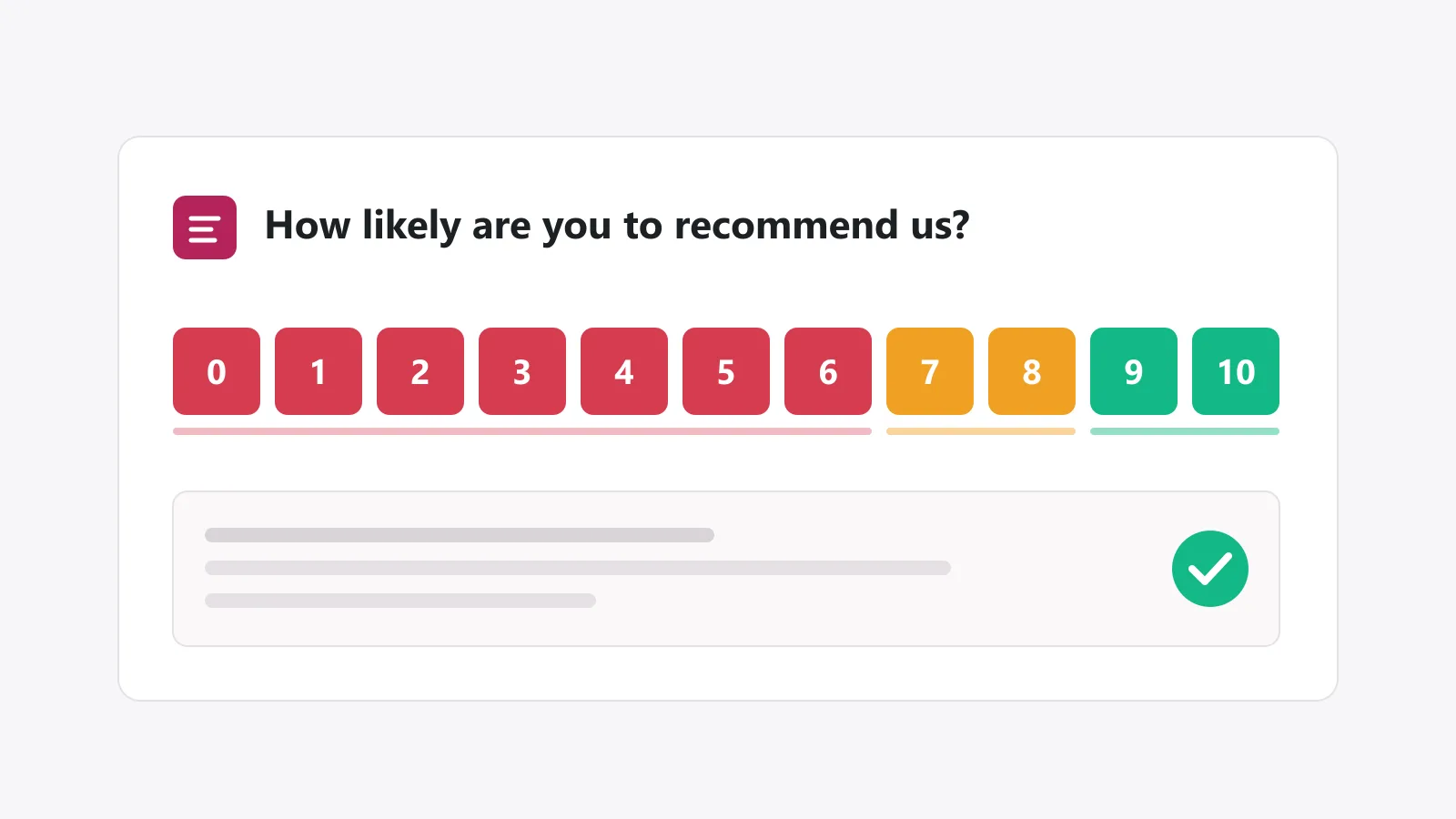
The standard NPS question is "How likely are you to recommend us to a friend or colleague?", answered on a scale from 0 (not at all likely) to 10 (extremely likely). That wording comes from Bain & Company's Net Promoter System, and almost every NPS survey uses it with the company or product name swapped in. Pair it with one open follow-up, "What is the main reason for your score?", and you have a complete survey.
The score question is fixed. The follow-up questions are where teams win or lose. This guide gives you the exact wording, 30 follow-up NPS survey questions sorted by score group, the employee version, when to send each type, and what a small support team should do with the answers once they land in the inbox.
In this guide
- The standard NPS question and its scale
- How the NPS question becomes a score
- 30 NPS follow-up questions by score group
- Employee NPS survey questions
- When to send an NPS customer survey
- Mistakes that quietly break NPS data
- Turning NPS answers into support work
- Sources
The standard NPS question and its scale
Every NPS survey is built around one question. Bain, which developed the method with Fred Reichheld, phrases it as: "How likely are you to recommend us to a friend or colleague?" Qualtrics uses a near-identical template: "How likely is it that you would recommend [Organization X/Product Y/Service Z] to a friend or colleague?" Both versions measure the same thing, so pick the one that reads more naturally in your product and keep it unchanged from survey to survey.
The idea goes back to Reichheld's December 2003 Harvard Business Review article, The One Number You Need to Grow. Its summary is blunt: companies spend lots of time and money on complex tools to assess customer satisfaction, but they are measuring the wrong thing. Two decades later, plenty of teams still send 20-question satisfaction surveys when one well-placed question would tell them more.
Why the NPS survey scale runs from 0 to 10
People often ask why the NPS question scale has 11 points instead of a tidy 1 to 5 or 1 to 10. Bain gives two reasons on its measurement page. First, starting at zero stops people from mixing up the ends of the scale, because a zero is never a good score. Second, 11 points give enough room that people do not default to the top box for an experience that was merely fine.
Wording variations that are safe to use
You can change the subject of the question without breaking comparability. "How likely are you to recommend Acme to a friend or colleague?" and "How likely are you to recommend our mobile app to a colleague?" are both fine. In B2B, "colleague" usually fits better than "friend". What you should not change is the scale, the anchor labels (0 = not at all likely, 10 = extremely likely), or the core verb "recommend". Once you ask "How satisfied are you?" on a 0 to 10 scale, you are running a satisfaction survey with NPS math on top, and the number stops meaning what NPS means.
Pro tip: Label only the two ends. Put "Not at all likely" under 0 and "Extremely likely" under 10, and leave the middle numbers bare. Labeling every point turns a quick tap into a reading exercise, especially on a phone.
How the NPS question becomes a score
Each answer to the NPS score question puts the respondent into one of three groups. Bain defines them like this:
- Promoters (9 to 10): loyal, enthusiastic fans. Bain says they account for more than 80% of referrals in most businesses.
- Passives (7 to 8): satisfied for now. Their repurchase and referral rates are as much as 50% lower than those of promoters, according to Bain.
- Detractors (0 to 6): unhappy customers who, in Bain's words, account for more than 80% of negative word of mouth.
Your Net Promoter Score is the percentage of promoters minus the percentage of detractors. Passives count toward the total number of responses but are not added or subtracted. The result sits between -100 and +100. Qualtrics gives a simple worked example: 70% promoters, 20% passives and 10% detractors produce an NPS of 70 minus 10, which is 60.
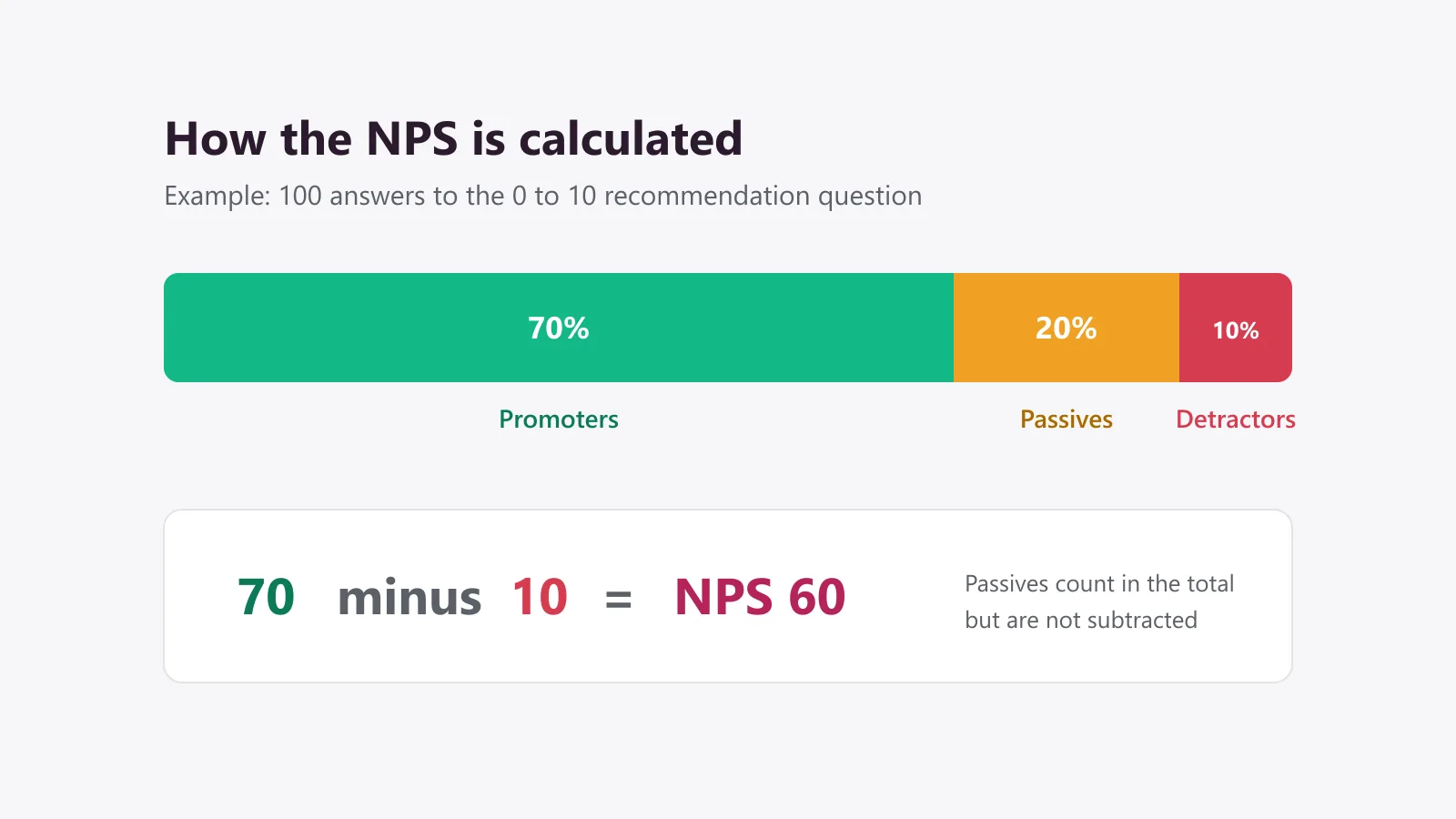
If you would rather not do this in a spreadsheet, our free NPS calculator takes raw counts and returns the score and the group split.
What counts as a good score
Qualtrics cites a framework from Bain: above 0 is good, above 20 is favorable, above 50 is excellent and above 80 is world-class. It also cautions that averages vary a lot by industry. Research from the Qualtrics XM Institute found an average NPS of 30 for grocery, 29 for video streaming and -6 for consumer payments. Our view: compare yourself with your own last quarter first and with "industry benchmarks" second. A support team that moves from 12 to 25 has learned something real. A team chasing a benchmark from a different industry has learned very little.
30 NPS follow-up questions by score group
The follow-up question explains the number, and it is the part your team can act on. Qualtrics lists the two most useful follow-ups as "What's the reason for your score?" and "How can we make your experience better?", and notes that they often produce the same answer, so you rarely need both.
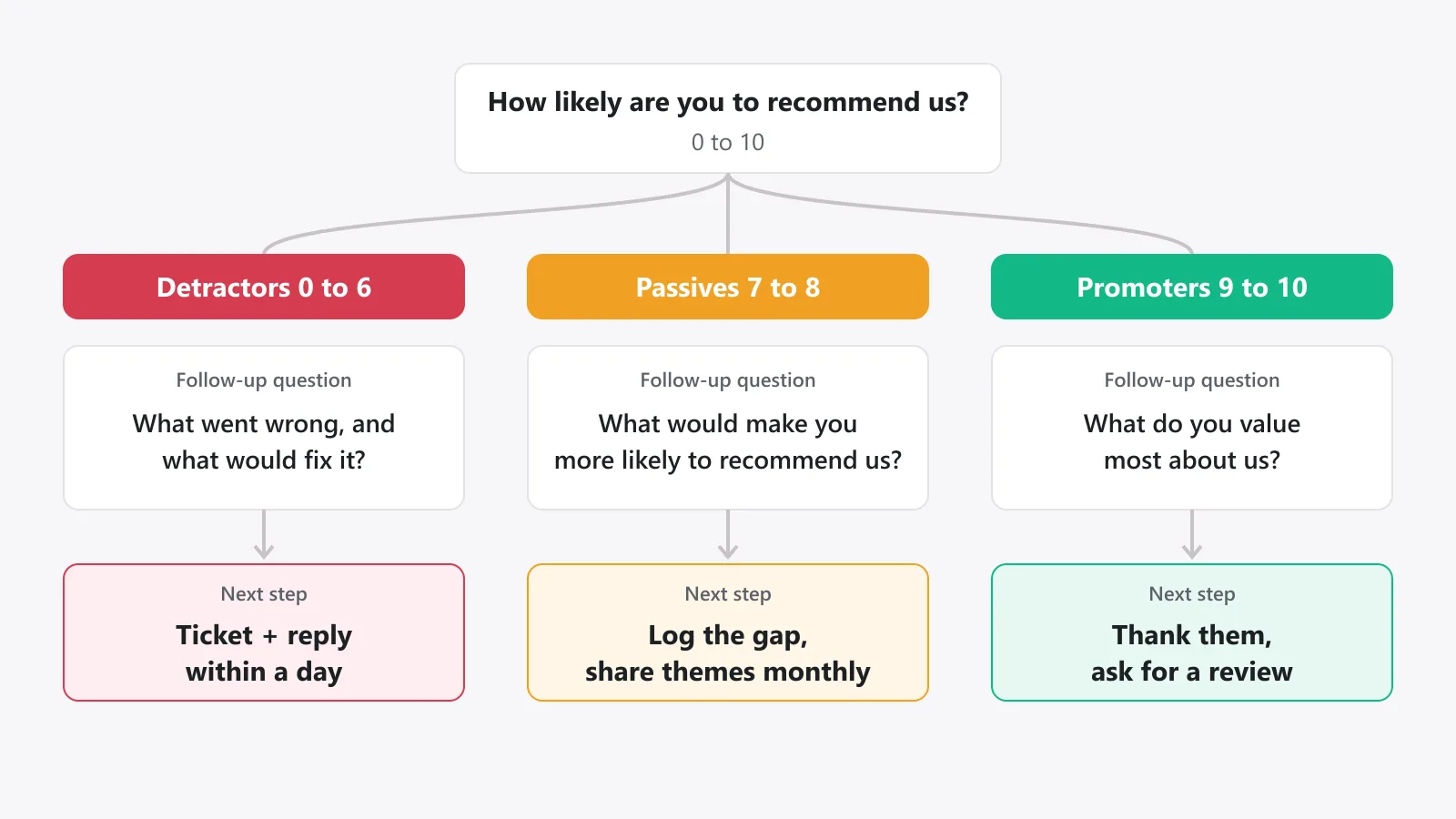
If your survey tool supports logic (also called branching or skip logic, which shows a different next question based on the previous answer), tailor the follow-up to the score group. Pick one question per group from the lists below. Do not ask all of them.
Universal follow-ups (any score)
- What is the main reason for your score?
- What is the one thing we could do to improve your experience?
- What, if anything, almost stopped you from giving a higher score?
- Which part of our product or service influenced your score the most?
- May we contact you about your answer? (Yes / No)
- Is there anything else you would like us to know?
Follow-up questions for detractors (0 to 6)
- What went wrong, and what would have fixed it?
- What did you expect that we did not deliver?
- Was your score about our product, our support, or our pricing?
- Is there an open issue we can help with right now?
- What would need to change for you to recommend us?
- Have you considered switching to another provider? If so, why?
- Would you like someone from our team to reach out today?
- How could we have resolved your last request better?
Keep the detractor survey short and the tone plain. Someone who just gave you a 3 does not want a marketing paragraph. They want proof that a person will read the answer.
Follow-up questions for passives (7 to 8)
- What would make you more likely to recommend us?
- What is missing that would make us a 10 for you?
- Which feature or service do you use most?
- Is there anything that slows you down when you use our product?
- How do we compare with other options you have tried?
- What almost made this a 9?
Passives get ignored more than any other group, and that is a mistake. They are, as Bain puts it, satisfied for now. One specific improvement can move a 7 to a 9, and their answers are usually the most concrete, because they like you enough to be specific and not enough to be polite.
Follow-up questions for promoters (9 to 10)
- What do you value most about working with us?
- What is the one thing we should never change?
- Which feature or part of our service do you rely on most?
- Who else do you think would benefit from our product?
- Would you be open to sharing a short review or testimonial?
- What almost stopped you from choosing us in the first place?
Question 26 is underrated. Promoters remember the doubts they had before buying, and those doubts are exactly what your website and onboarding should answer.
Optional context questions
- How long have you been a customer? (skip this if your CRM already knows)
- What is your role? (useful in B2B, where users and buyers differ)
- Which plan are you on? (again, skip if you can match it from account data)
- Which channel do you usually use to contact our support team?
Qualtrics advises avoiding demographic questions when you can get the answers from data you already have in other systems, like a CRM or customer database. The same logic applies to every question on this last list. Each one you can fill from account data is one fewer question for the customer.
Key takeaway: One NPS question plus one follow-up is a complete survey. Every extra question has to pay for itself with a decision it feeds. If you cannot name that decision, cut the question.
Employee NPS survey questions
Employee NPS (eNPS) borrows the same NPS question structure to measure how employees feel about their workplace. Bain's Employee Net Promoter System page says most adopters have settled on one central question: "How likely would you recommend this company as a place to work?" Bain adds that a second question, typically agreement with the statement "My job inspires me", can be the best predictor of energy, enthusiasm and creativity.
A practical employee net promoter survey looks like this:
- How likely would you recommend this company as a place to work? (0 to 10)
- To what extent do you agree: "My job inspires me"? (Strongly disagree to Strongly agree)
- What is the main reason for your score? (optional, open text)
- What is one thing that would make this a better place to work? (optional, open text)
Three differences from a customer NPS survey matter. Bain says employee feedback must be kept confidential, which means no one-on-one follow-ups like you would do with a customer. It notes that companies most commonly run eNPS monthly, far more often than the classic annual employee survey. And it warns that employee scores can be substantially lower than customer scores, because employees often hold their company to higher standards.
Not everyone agrees eNPS is enough on its own. Qualtrics recommends against using eNPS as your main employee feedback tool, pointing to small sample sizes, unlabeled scale points and limited actionable insight, and suggests full engagement surveys instead. Our take for small teams: a monthly two-question eNPS pulse is a reasonable early warning signal for a support team, as long as you do not treat it as a full picture of team health.
When to send an NPS customer survey
There are two ways to run an NPS customer survey, and they answer different questions.
| Survey type | What it measures | When to send | Good fit for |
|---|---|---|---|
| Relationship NPS | How the customer feels about you overall | On a schedule, such as quarterly or yearly | Tracking loyalty over time |
| Transactional NPS | How one interaction went | Right after a purchase, onboarding step or support case | Rarely the right tool; CSAT usually fits better |
| CSAT (for comparison) | Satisfaction with one moment | Right after the moment, such as a resolved ticket | Day-to-day support quality |
Here is the part many NPS guides skip. Qualtrics describes relational NPS surveys as deployed quarterly or annually, and it does not recommend using NPS on a transactional basis at all. Its reasoning: NPS measures an overall relationship, and asking too soon or after too small an interaction risks annoying customers.
We agree, and it matters for help desks in particular. Asking the NPS question five minutes after a password reset mixes up two things: how the agent did and how the customer feels about your whole company. For post-ticket feedback, a one-question CSAT survey is the cleaner tool. Our guide to customer satisfaction survey questions covers that side, and the CSAT guide explains how to report it.
For relationship NPS, a few practical rules:
- Send on a fixed rhythm. Quarterly is common. Changing the timing changes the result.
- Do not survey someone in the middle of an open problem. If a customer has an unresolved urgent ticket, their answer will be about that ticket. Wait until it is closed, or the score measures one bad week rather than the relationship.
- Survey accounts, not only users, in B2B. A champion and an occasional user can give very different scores for the same account.
Pro tip: Keep the first question one tap away. Embed the 0 to 10 buttons directly in the email so the click itself records the score, then show the follow-up on the landing page. Customers who would never open a survey link will often tap a number.
Mistakes that quietly break NPS data
Most broken NPS programs fail through survey design, not through bad customers. These are the mistakes worth checking before you hit send.
Adding too many questions. SurveyMonkey analyzed 100,000 surveys, 2,000 at each length from 1 to 50 questions, and found that the sharpest increase in drop-off rate comes with each additional question up to 15 questions. The data is older (surveys from 2009 to 2010), but the direction is consistent with what every survey team sees: each extra question costs responses. An NPS survey that grows to 12 questions is no longer an NPS survey.
Asking the NPS question at the wrong moment. As covered above, transactional NPS after every ticket measures the ticket, not the relationship.
Coaching the answer. "We worked hard to earn a 10. How likely are you to recommend us?" is a request for a favor, not a measurement. The same goes for agents telling customers that "anything below a 9 counts as a fail". The scores go up and the data becomes useless.
Changing the NPS question between waves. If you switch from "friend or colleague" to "a business like yours" mid-year, you cannot tell whether a score change is real or caused by the wording.
Reading only the number. A score of 31 tells you nothing about what to fix. The open follow-up answers do. Tag them by theme (onboarding, pricing, a missing feature, slow replies) and the top three themes become your next quarter's priorities.
Collecting feedback you never answer. If a customer ticks "Yes, you may contact me" and nobody does, you have taught them that the survey is a formality. That leads straight to the last section.
Turning NPS answers into support work
An NPS survey earns its keep in the days after the answers arrive. This step is often called closing the loop: contacting respondents, especially detractors, to understand and fix what went wrong. It is also where a help desk does most of the work, because the follow-up is a conversation, not a chart.
A simple workflow that fits a small team:
- Turn every detractor comment into a ticket. Forward survey replies into your shared inbox or create a ticket per detractor in your ticketing system. Give it an owner, a priority and a tag such as "nps-detractor".
- Set a response target. A detractor who hears back within a day feels heard. One who hears back in three weeks feels processed. A target with SLA management makes the deadline visible to the whole team.
- Reply like a person. Reference what they actually wrote, say what you will do, and give a date. Our guide to writing a customer service email has templates for this kind of message, and the canned response generator can draft a starting point you then personalize.
- Thank promoters and ask one small favor. A short note and a link to a review site or a referral page is enough.
- Fix the pattern, not only the case. If five detractors mention the same missing help article, write it in your knowledge base. Repeated questions are also good candidates for customer service automation.
A note on Kora Reply itself: we are a new help desk for small teams, and built-in survey sending and NPS reporting are on our roadmap, not live today. Until they ship, you can run the survey in any survey tool, calculate the result with our free NPS calculator, and handle the follow-up work inside Kora Reply tickets with owners, internal notes and response targets. You can see what each plan includes on the pricing page.
Frequently asked questions
Bain & Company, which created the Net Promoter System, phrases it as "How likely are you to recommend us to a friend or colleague?" Customers answer on a 0 to 10 scale, where 0 means not at all likely and 10 means extremely likely. Most companies replace "us" with their company, product or service name.
NPS stands for Net Promoter Score. It is the percentage of promoters (people who answer 9 or 10) minus the percentage of detractors (people who answer 0 to 6). The result ranges from -100 to +100.
Two is the sweet spot: the 0 to 10 recommendation question and one open follow-up such as "What is the main reason for your score?" Add a third only if it feeds a real decision, for example permission to contact the customer. SurveyMonkey's analysis of 100,000 surveys found that drop-off rises most sharply with each added question up to 15 questions.
"What is the primary reason for your score?" works for everyone. If your survey tool supports logic, tailor it: ask promoters what they value most, passives what would make them more likely to recommend you, and detractors what went wrong.
Usually not. Qualtrics recommends against using NPS on a transactional basis because NPS measures the overall relationship, and asking too often or after small interactions can annoy customers. After a ticket, a CSAT question is the better fit. Run NPS on a schedule, such as quarterly.
Bain's guidance for employee NPS (eNPS) uses "How likely would you recommend this company as a place to work?" on the same 0 to 10 scale. Bain notes that most companies run eNPS monthly, keep it to a few questions, and keep answers confidential.
Bain explains that the 11-point scale is familiar, avoids people mixing up the ends of a 1 to 10 scale because a zero is never a good score, and gives enough choice that people do not default to the top box for a merely satisfactory experience.
Sources
Every statistic and quoted guideline in this article comes from the pages below, checked on October 25, 2026.
- Bain & Company, Net Promoter System, Measuring your Net Promoter Score: the standard question, the 0 to 10 scale and why it is used, promoter, passive and detractor ranges, the NPS formula, promoters' share of referrals, passives' lower repurchase and referral rates, detractors' share of negative word of mouth.
- Bain & Company, Net Promoter System, The Employee Net Promoter System: the eNPS question, the "My job inspires me" question, confidentiality, monthly frequency, eNPS often lower than customer scores.
- Qualtrics, What is NPS? The ultimate guide to boosting your Net Promoter Score: question template, -100 to +100 range, worked example, Bain scoring framework, Qualtrics XM Institute industry averages, relational versus transactional NPS, follow-up questions, advice on demographic questions, limits of eNPS.
- SurveyMonkey, Does adding one more question impact survey completion rate?: analysis of 100,000 surveys from 2009 to 2010, sharpest drop-off increase up to 15 questions.
- Frederick F. Reichheld, Harvard Business Review, The One Number You Need to Grow (December 2003).
Related articles
 Customer feedback
Customer Satisfaction Survey Questions: 40 Examples to Use
40 customer satisfaction survey questions for support, onboarding, product and self-service, plus how long a survey should be and how to score it.Read article Support skills